
Typical symptoms
- Back pain triggered by movement and relieved at rest
- Locking sensation when changing position
- Buttock or leg pain that varies with posture
- Difficulty staying seated or standing for long periods
SPINE CONDITION
A back that seems to give way, that locks when you change position and aches the moment you stay upright too long — that instability often comes from one vertebra slipping on the one below (spondylolisthesis) or from worn joints letting a segment move too much. The result is mechanical back pain, sometimes with nerve compression and leg pain on top. The good news is that the unstable segment can be pinpointed and treated.
Instability often combines mechanical back pain with nerve symptoms. Identifying which segment is unstable is critical before considering surgery.
Instability has two main origins: isthmic spondylolisthesis (a stress fracture in the pars interarticularis, often originating in adolescence) and degenerative spondylolisthesis (facet joint wear in adults over 50). Both can be tolerated for years and only become symptomatic when the segment loses control.
Dynamic standing X-rays in flexion and extension are essential — they quantify motion that a single MRI cannot show. A multidisciplinary review then weighs symptoms, function and imaging before choosing between rehabilitation and surgery.
We always start with the least invasive option that delivers durable relief. Surgery is reserved for cases where conservative care has failed or red flags are present.
Stage 1
Specific core and gluteal training, motor control work, manual therapy and ergonomic advice. Often controls grade I slippages without surgery.
Stage 2
When the segment is stable but a nerve root is compressed, a targeted microsurgical decompression resolves leg pain while preserving motion.
Stage 3
Indicated when slippage progresses or instability is mechanical. Modern instrumented fusion uses 3D navigation, percutaneous screws and interbody cages to restore alignment with limited blood loss.
Surgical technology
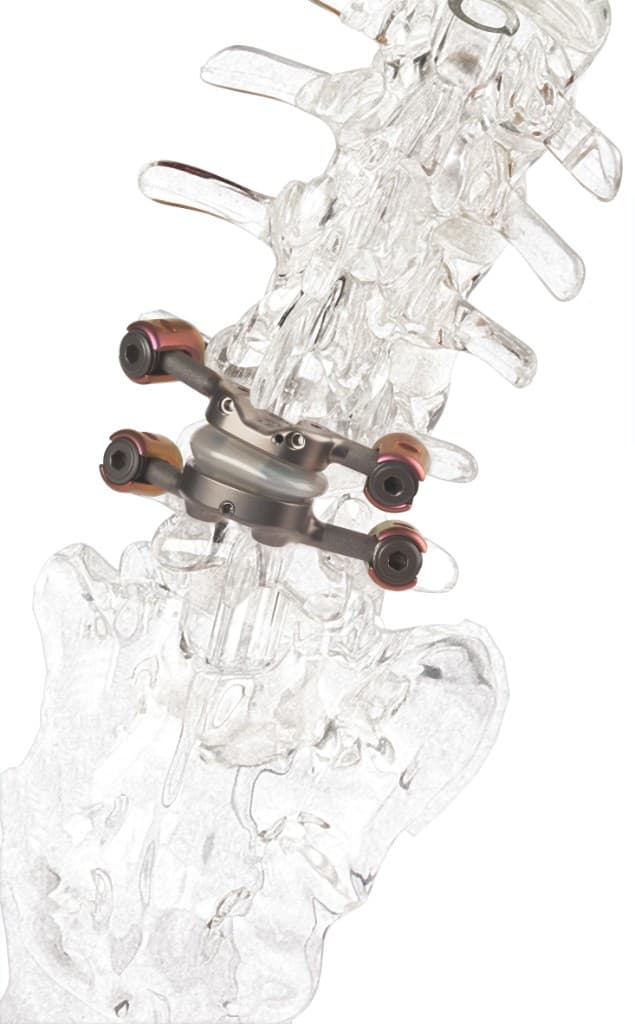
Dedicated international slots reserved with our French partner surgeons — no 12 to 18 month waiting list.
Minimally invasive procedures, intra-operative imaging and the latest implants — often unavailable locally.
Coordination from Montréal to France in French and English, with your home physician kept in the loop.
Detailed pricing before any procedure, insurance support and no hidden fees.
Step 1
45-minute appointment with our clinical nurse specialist to review imaging, symptoms and history.
Step 2
Your case is shared with the most relevant French spine surgeon. Treatment plan delivered within 48 hours.
Step 3
Concierge organises stay, transport and admission. Surgery takes place in a partner centre of excellence.
Step 4
Post-op recovery in Québec with shared follow-up between Franchir's team and your home physician.
Patient story
Benoît, a Quebec patient who received an L5-S1 disc replacement, shares his journey with Franchir and his new pain-free life.
with Dr Brauge
Send us your imaging and medical history. A specialist reviews your file and confirms whether surgery is the right option — for free.
Published · Updated